LifeStraw vs Clearly Filtered: The Ultimate Water Pitcher Comparison
Updated March 2025 — by the OsmosisInfo Editorial Team
The short answer: Clearly Filtered removes significantly more contaminants (365+) including fluoride, arsenic, and PFAS, making it the top choice for comprehensive protection. LifeStraw Home excels at removing biological threats (bacteria, parasites, microplastics) and has a longer-lasting membrane filter — making it ideal for households concerned about pathogens and portability. Both are excellent pitchers; the right one depends entirely on what’s in your water.
Table of Contents
Quick Product Overview
Both the LifeStraw Home and Clearly Filtered pitchers sit at the premium end of the water filter pitcher market. They share some qualities — gravity-fed filtration, BPA-free construction, large capacity — but they use fundamentally different filtration philosophies. Understanding those differences is the key to making the right choice.

LifeStraw Home 10-Cup Water Filter Pitcher
Best for biological protection, microplastics & PFAS — with an industry-leading membrane filter.
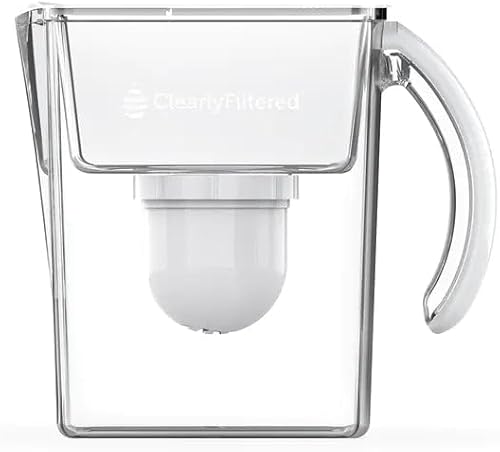
Clearly Filtered Water Filter Pitcher
Best for comprehensive chemical removal — certified to reduce 365+ contaminants including fluoride & arsenic.
Spec Comparison Table
| Feature | LifeStraw Home 10-Cup | Clearly Filtered |
|---|---|---|
| Capacity | 2.4 L (10 cups) | 2.4 L (10 cups / 80 oz) |
| Filter Technology | Hollow fibre membrane + activated carbon/ion exchange | Woven mesh + granulated carbon + composite ionic shell |
| Contaminants Targeted | 30+ (bacteria, parasites, PFAS, lead, microplastics) | 365+ |
| Bacteria Removal | 99.9999% | 99.9%+ |
| Parasite Removal | 99.999% | High |
| Fluoride Removal | Limited | Up to 99% |
| PFAS Removal | >99% | >99.9% |
| Lead Removal | >99% | >99.3% |
| Arsenic Removal | Limited | Up to 99.6% |
| Microplastics Removal | Yes | Yes |
| Membrane Filter Life | 264 gallons (~1 year) | — |
| Carbon Filter Life | 40 gallons (~2 months) | 100 gallons (~4 months) |
| BPA-Free | Yes | Yes (medical-grade Tritan) |
| Flow Rate | Moderate | Moderate |
| Material | BPA-free plastic or glass | BPA/BPS-free Tritan plastic |
| Third-Party Tested | Yes (NSF/ANSI standards) | Yes (NSF/ANSI 42, 53, 58, 401, P473) |
| Annual Filter Cost | ~AU $80–$100 | ~AU $60–$90 |
| Price (Pitcher) | ~AU $85–$120 | ~AU $100–$150 |
LifeStraw Home — Full Review
LifeStraw is a brand that built its reputation on saving lives in disaster and field conditions. Their iconic straw filters have been deployed in over 50 countries. The LifeStraw Home pitcher brings that same commitment to biological safety into a stylish, modern kitchen-friendly package.
How the Filter Works
The LifeStraw Home uses a two-stage filtration system. The first stage is a hollow fibre membrane microfilter — the same technology used in their famous field straws. This membrane physically blocks particles larger than 0.2 microns, which eliminates bacteria (99.9999%), parasites (99.999%), and microplastics. The second stage is an activated carbon + ion exchange filter that reduces chemical contaminants: chlorine, chloramine, PFAS (including PFOA and PFOS by more than 99%), lead, mercury, and VOCs.
Importantly, these two stages are sold as separate replacement filters with different lifespans. The membrane filter lasts an impressive 264 gallons (~1,000 litres or about 1 year) for an average household. The carbon filter needs replacing every 40 gallons (~150 litres or roughly 2 months).
Design & Build Quality
The LifeStraw Home comes in plastic and glass versions. The plastic version is available in multiple colours (Seafoam, Midnight Blue, White) and fits comfortably in most refrigerator doors. The glass version (sold separately) adds a premium feel and eliminates any concerns about plastic leaching, though it’s heavier and less durable. The 10-cup size offers excellent value for families.
Build quality is generally excellent. The lid fits snugly, the pour spout is smooth, and the large reservoir design means you can fill it up and let it filter without constantly babysitting it. Some users note the flow rate is a little slow — expect to wait 15–20 minutes for a full 10-cup reservoir to filter through.
What LifeStraw Home Does Better Than Anyone
If biological contaminant removal is your priority — bacteria, Giardia, Cryptosporidium, or if you have any doubts about your water source’s microbial safety — LifeStraw’s membrane technology is genuinely best-in-class among pitchers. No competitor matches their 6-log bacteria removal in a pitcher format. If you travel, camp, or live somewhere with questionable tap water safety, this matters enormously.
✅ Pros
- Industry-leading bacteria & parasite removal (99.9999%)
- Excellent microplastics filtration
- >99% PFAS reduction (PFOA, PFOS)
- Long-lasting membrane filter (264 gallons)
- Available in glass for zero-plastic contact
- Stylish modern design, multiple colours
- Strong brand with genuine humanitarian mission
- Solid third-party test certification
❌ Cons
- Carbon filter needs replacement every ~2 months
- Does not remove fluoride significantly
- Limited arsenic & uranium removal
- Covers only 30+ contaminants vs 365+ for Clearly Filtered
- Slower flow rate than basic Brita-style pitchers
- Glass version is heavier and more expensive
LifeStraw Home 10-Cup Water Filter Pitcher
Best for: Biological safety, microplastics, PFAS removal
Clearly Filtered — Full Review
Clearly Filtered takes a different approach to water filtration. While LifeStraw targets biological threats, Clearly Filtered focuses on chemical contamination — and their breadth of coverage is genuinely remarkable. With third-party certification against 365+ contaminants to NSF/ANSI standards 42, 53, 58, 401, and P473, no other pitcher on the market approaches this level of documented protection.
How the Filter Works
The Clearly Filtered pitcher uses a proprietary 3-layer filtration system called Affinity Filtration Technology. The first layer is a woven stainless steel mesh that catches large particles. The second layer is granulated coconut carbon, which is extremely effective at removing chlorine, chloramines, and organic chemicals. The third layer is a composite ionic shell that uses ionic attraction to pull heavy metals, PFAS, fluoride, and other charged contaminants out of the water.
The filter is rated for 100 gallons (~380 litres) — that’s roughly 4–5 months for an average household. This is meaningfully longer than LifeStraw’s carbon stage (40 gallons), reducing your filter replacement frequency and ongoing cost.
The Fluoride Advantage
This is where Clearly Filtered separates itself from nearly every competitor. Most activated carbon filters — including LifeStraw’s — do not meaningfully reduce fluoride. Fluoride reduction requires specific ion exchange media or reverse osmosis. Clearly Filtered’s composite ionic filter is independently certified to remove fluoride by up to 99%, which is extraordinary for a pitcher-style filter. If fluoride is a concern for you or your family, this is effectively the only mainstream pitcher that addresses it adequately.
Contaminant Coverage
Clearly Filtered publishes a detailed performance data sheet showing test results for every contaminant they claim to remove. Highlights include: arsenic (>96%), uranium (>98%), chromium-6 (>99%), nitrates (>96%), PFAS (>99.9%), pharmaceuticals (>99%), hormones (>98%), and more. This level of transparency and documentation is rare and genuinely impressive.
Design Updates in 2025
Clearly Filtered updated their pitcher design based on customer feedback. The reshaped upper tank makes it easier to pour water without spilling when the filter is still active. The Tritan plastic is medical-grade, BPA-free, BPS-free, and free of estrogen/androgen activity — important for households with health-sensitive members. The 10-cup (80 oz) capacity covers the lower reservoir, so you always have a full pitcher of clean water ready.
✅ Pros
- Certified against 365+ contaminants — most in class
- Removes fluoride up to 99% (unique for pitchers)
- Excellent arsenic, uranium, heavy metal removal
- Longer carbon filter life (100 gallons)
- Medical-grade Tritan plastic, free of estrogen activity
- Transparent published lab results
- Updated 2025 design, easier to pour
- NSF/ANSI certified to 5 different standards
❌ Cons
- Weaker biological removal vs LifeStraw’s membrane
- No dedicated hollow fibre membrane for bacteria
- Higher upfront cost than budget pitchers
- Replacement filters can be hard to source locally in AU
- Slow filtration speed (gravity fed)
- Heavier than basic pitchers
Clearly Filtered Water Filter Pitcher
Best for: Fluoride, arsenic, PFAS, 365+ contaminants
Head-to-Head Comparison
| Category | LifeStraw Home | Clearly Filtered | Winner |
|---|---|---|---|
| Biological Safety (bacteria/parasites) | ★★★★★ | ★★★★ | LifeStraw |
| Chemical Contaminant Range | ★★★ | ★★★★★ | Clearly Filtered |
| Fluoride Removal | ★ | ★★★★★ | Clearly Filtered |
| PFAS Removal | ★★★★ | ★★★★★ | Clearly Filtered |
| Microplastics Removal | ★★★★★ | ★★★★ | LifeStraw |
| Filter Longevity (carbon stage) | ★★★ (40 gal) | ★★★★★ (100 gal) | Clearly Filtered |
| Transparency / Certifications | ★★★★ | ★★★★★ | Clearly Filtered |
| Design & Aesthetics | ★★★★★ | ★★★★ | LifeStraw |
| Ease of Use | ★★★★ | ★★★★ | Tie |
| Value for Money | ★★★★ | ★★★★ | Tie |
| Overall | ★★★★ (4.0/5) | ★★★★½ (4.5/5) | Clearly Filtered |
Contaminant Removal Deep Dive
Most water filter reviews focus on chlorine removal and taste improvement — the basics. But if you’re comparing premium pitchers, the more important question is what they remove from tap water that you can’t taste or smell: heavy metals, industrial chemicals, pharmaceutical residues, and legacy contaminants like PFAS (forever chemicals).
PFAS (Forever Chemicals)
Both pitchers perform strongly here. LifeStraw’s membrane + carbon combination achieves >99% reduction of PFOA and PFOS. Clearly Filtered’s Affinity system hits >99.9% across a broader range of PFAS compounds. For PFAS specifically, Clearly Filtered’s lead is marginal but real.
Fluoride
This is a significant differentiator. Australian tap water is fluoridated at 0.6–1.0 mg/L in most capital cities. Many families prefer to reduce or eliminate fluoride from drinking water, especially for young children and infants. LifeStraw Home does not meaningfully remove fluoride. Clearly Filtered removes it up to 99%, independently verified. If fluoride reduction matters to you, Clearly Filtered is the only realistic pitcher choice.
Heavy Metals
Both pitchers remove lead well (>99%). Clearly Filtered also covers arsenic (>96%), chromium-6 (>99%), cadmium, uranium, and more. LifeStraw’s ion exchange stage handles lead and mercury but doesn’t address the broader spectrum of metals that Clearly Filtered targets.
Biological Contaminants
This is LifeStraw’s home turf. Their hollow fibre membrane physically removes 99.9999% of bacteria including E. coli, Salmonella, and Legionella, and 99.999% of protozoa including Giardia and Cryptosporidium. This is a genuine performance advantage. Australian tap water is generally safe, but for households on tank water, bore water, or in areas with aging infrastructure, this biological safety margin has real value.
— On town/city water worried about chemicals, PFAS, fluoride → Choose Clearly Filtered
— On tank, bore, or rural water with biological concerns → Choose LifeStraw Home
— For travelling or preparedness scenarios → Choose LifeStraw Home
Cost & Filter Replacement
Both pitchers sit in the premium tier upfront, but the real cost comparison is lifetime ownership — specifically, how often you replace filters and how much they cost.
| Cost Item | LifeStraw Home | Clearly Filtered |
|---|---|---|
| Pitcher (upfront) | ~AU $85–$120 | ~AU $100–$150 |
| Membrane filter (1 yr) | ~AU $35–$45 | Not applicable |
| Carbon filter replacements (per year) | ~6 per year (~AU $50–$65) | ~3 per year (~AU $45–$60) |
| Total Year 1 Cost | ~AU $170–$230 | ~AU $145–$210 |
| Annual Ongoing Cost | ~AU $85–$110 | ~AU $45–$60 |
Over a 3-year ownership period, Clearly Filtered actually works out cheaper despite a higher upfront cost, primarily because its filter lasts 2.5x longer than LifeStraw’s carbon stage. LifeStraw’s membrane filter is exceptional value ($35–$45 per year), but the more frequent carbon replacements add up.
Clearly Filtered saves approximately AU $100–$170 over three years despite costing more upfront.
Frequently Asked Questions
No — not to any significant degree. LifeStraw’s activated carbon stage has minimal effect on fluoride ions. If fluoride reduction is a priority, Clearly Filtered is the correct choice, as it removes up to 99% of fluoride via its ionic composite filter.
For most Australian city households on chlorinated, fluoridated mains water, Clearly Filtered provides more relevant protection — removing fluoride, PFAS, heavy metals, and a broader chemical spectrum. For rural Australians on tank or bore water, LifeStraw’s biological removal (bacteria, Giardia) is more valuable.
LifeStraw Home has two separate filters: the membrane filter lasts ~264 gallons (~1,000 litres, about 1 year), and the carbon filter lasts ~40 gallons (~150 litres, about 2 months). Clearly Filtered’s single filter lasts ~100 gallons (~380 litres, about 4 months) — significantly longer for the carbon stage.
For most households, yes. The breadth of contaminant removal, including fluoride, arsenic, and hundreds of chemical compounds, makes it a genuinely superior filter for comprehensive protection. The longer filter life also offsets the higher upfront cost over time.
LifeStraw Home is the better choice for tank or bore water due to its hollow fibre membrane that physically removes bacteria and parasites. Clearly Filtered does not have a dedicated membrane microfilter, so it offers less biological protection. For tank/bore water, LifeStraw is strongly recommended.
Neither is a water softener — they do not remove the hardness minerals (calcium and magnesium) that cause scale buildup. If hard water scale is your main concern, you need a dedicated water softener. Both pitchers do remove some hardness-related mineral contaminants (like excess calcium precipitates) but are not designed for this purpose.
Clearly Filtered is typically recommended for families with young children and infants because of its fluoride removal capability and broad pharmaceutical/hormonal contaminant coverage. LifeStraw is excellent if microbiological safety is also a priority. Ideally, families with health concerns should also consider testing their tap water to understand what specific contaminants are present.
Final Verdict
After reviewing filtration performance, cost, certification breadth, and real-world usability, Clearly Filtered is our top recommendation for most Australian households — particularly for city water users concerned about fluoride, PFAS, heavy metals, and chemical contamination.
LifeStraw Home wins decisively for biological safety, microplastics removal, and design aesthetics. It’s the better choice for rural/tank water users, travellers, and anyone who prioritises pathogen removal over chemical breadth.
| LifeStraw Home | Clearly Filtered | |
|---|---|---|
| Overall Rating | ★★★★ 4.0/5 | ★★★★½ 4.5/5 |
| Best For | Biological safety, microplastics, PFAS | Fluoride, heavy metals, 365+ contaminants |
| Price | ~AU $85–$120 | ~AU $100–$150 |
| Filter Life | Membrane 1 yr / Carbon 2 mo | Single filter ~4 months |
| 3-Year Cost | ~AU $420–$560 | ~AU $285–$390 |
| Certified Standards | NSF/ANSI 42, 53, 244 | NSF/ANSI 42, 53, 58, 401, P473 |
Where to Buy in Australia
Both products are available from international retailers shipping to Australia. Amazon AU offers reliable delivery and competitive pricing, while eBay AU often has competitive listings from Australian and international sellers.
Leave a Reply